Workloads
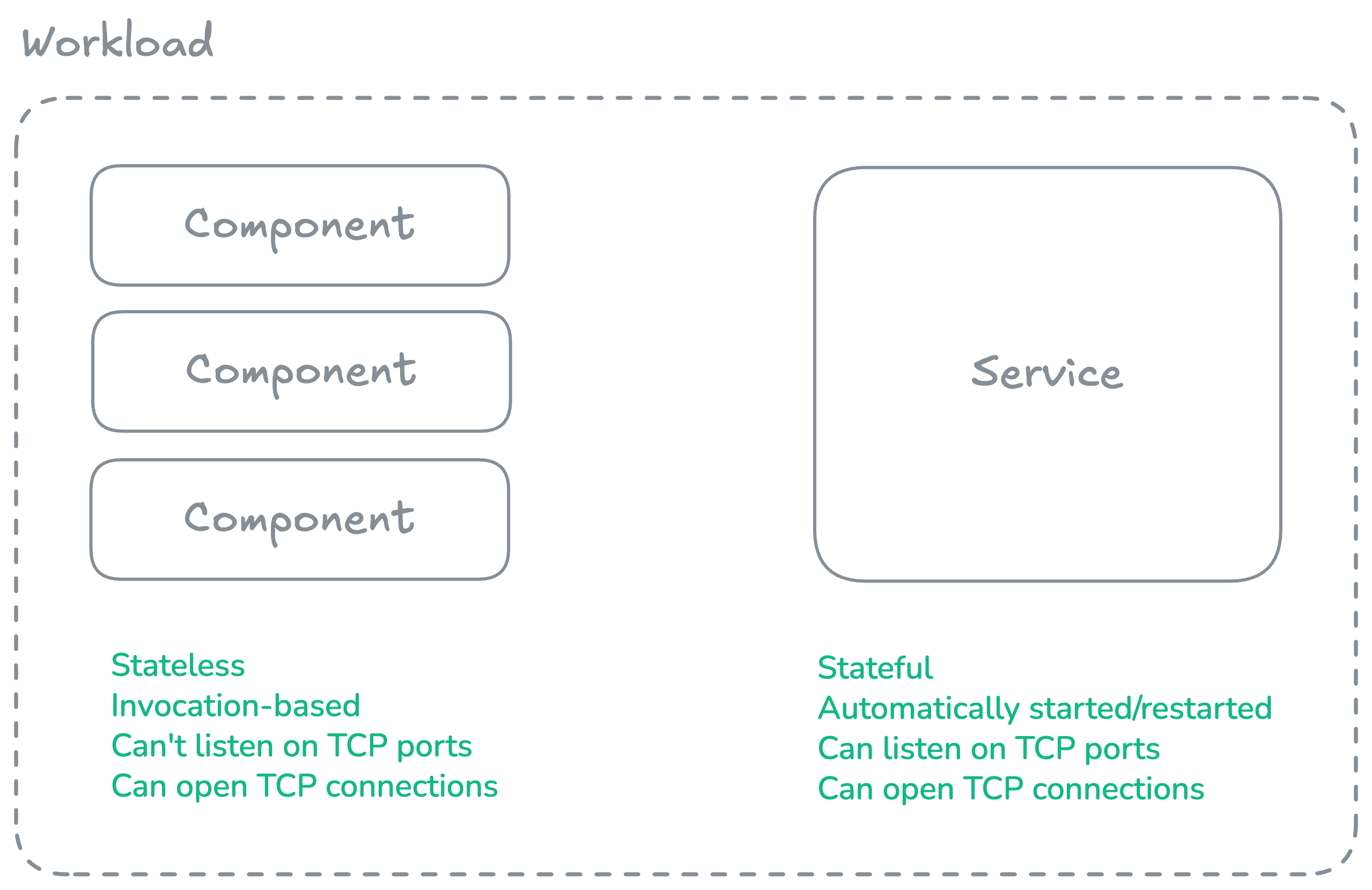
Workloads are composed of one or more WebAssembly (Wasm) components and an optional service.
A wasmCloud workload is an application-level abstraction that consists of one or more components and optionally a service.
-
Components are portable, interoperable binaries (
.wasmfiles) that implement stateless logic, typically enacting the core logic of an application (for example, the API for a web application), while leaving stateful or reusable functionality (e.g., key-value storage or HTTP) to services, hosts, and host plugins.- You can find a simple example of a Rust-based "Hello world!" component in
wash/examples.
- You can find a simple example of a Rust-based "Hello world!" component in
-
Services are persistent, stateful Wasm binaries that can act as
localhostwithin the workload boundary and provide long-running processes.- You can find a simple example of a Rust-based cron service in
wash/examples.
- You can find a simple example of a Rust-based cron service in
The wasmCloud host runs workloads in cloud and edge environments, while the Wasm Shell (wash) CLI helps developers build and publish components and services.
Workloads are defined according to the wasmCloud runtime's Workload API. For most users, this means defining the workload in a Kubernetes manifest with the WorkloadDeployment custom resource.
Usage
Workloads are application-level units that combine components and services. Example use cases include:
- Microservices: Deploy a workload as a single microservice—for example, an order processing service with a component handling business logic and a service maintaining database connections.
- API backends: Build HTTP APIs where components handle request routing and response generation while services manage authentication state or connection pools.
- Event processors: Create workloads that respond to events from message queues, with components processing messages and services maintaining connections to the queue.
- Scheduled jobs: Run batch processing workloads where a cron service triggers component invocations on a schedule.
Components vs Services
| Feature | Components | Services |
|---|---|---|
| Lifecycle | Invocation-based (stateless) | Long-running (stateful) |
| State | No state between invocations | Maintains state across lifetime |
| TCP Listening | ❌ Cannot listen on ports | ✅ Can listen on TCP ports |
| TCP Outbound | ✅ Can connect out | ✅ Can connect out |
| Execution Model | Invoked per request | Runs continuously (like traditional binaries) |
| WASI Interface | Component model | wasi:cli/run |
| Restart Policy | N/A (invoked as needed) | Automatically restarted on crash |
Use a component when you need:
- Stateless request/response patterns
- Pure computation or transformation
- Scaling with invocation-based concurrency
- Standard WIT interface implementations
Use a service when you need:
- Persistent connections (database connection pooling)
- Long-running state (in-memory caches)
- TCP server capabilities
- Cron/scheduled task execution
- Protocol adapters and bridges
Keep reading
- Continue to learn more about WebAssembly (Wasm) components.
- Learn more about services.