Runtime
wasmCloud's runtime (wash-runtime) is a simple, flexible runtime environment for WebAssembly workloads.
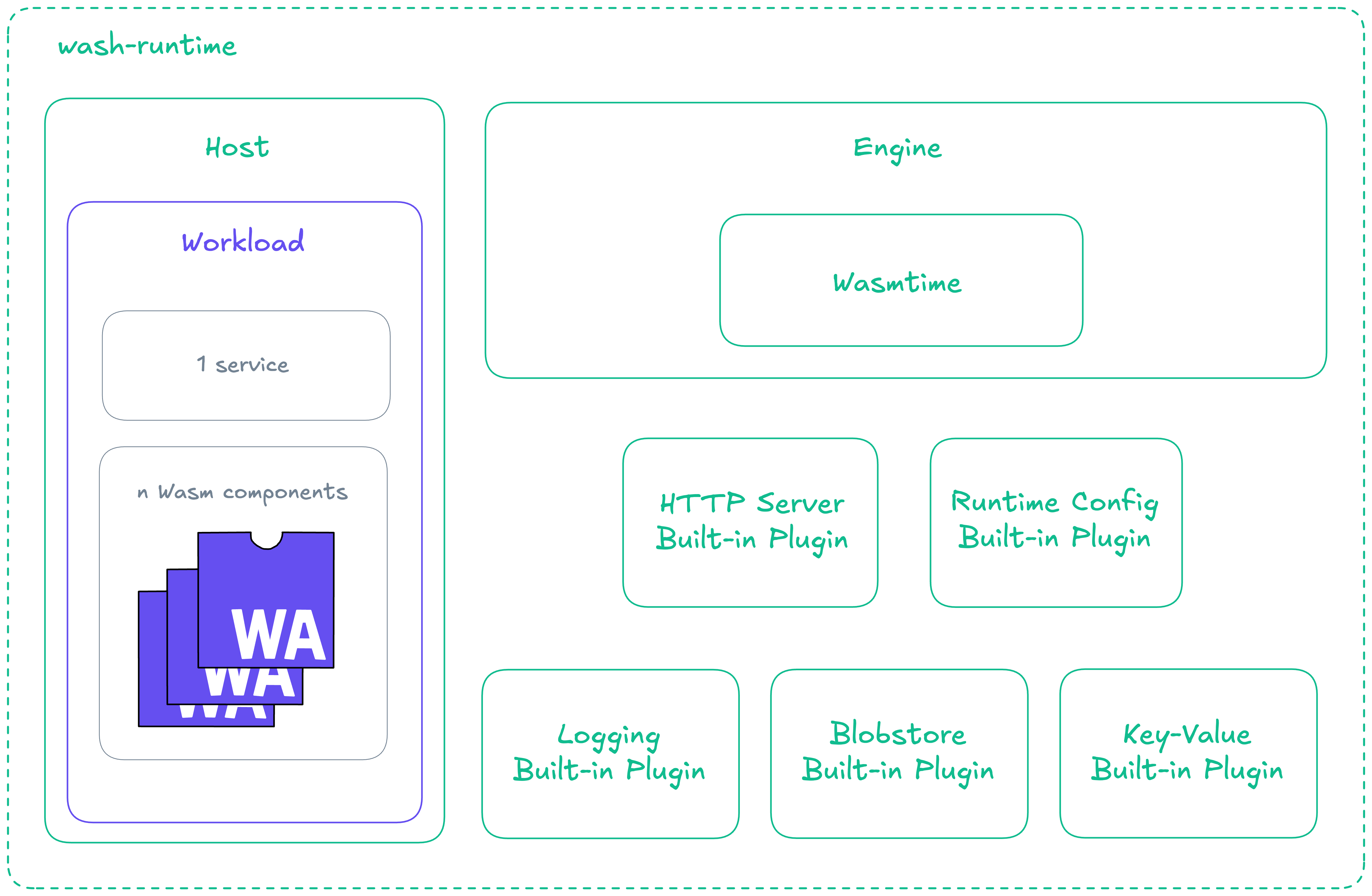
wash-runtime is a Rust crate that includes Wasmtime as the underlying runtime engine, as well as the wasmCloud host, which serves as a runtime environment for WebAssembly components. A plugin system allows for extension of the host with new and custom capabilities.
The runtime provides easy-to-use abstractions over the low-level Wasmtime API, as well as wasmCloud-specific APIs for managing workloads, handling NATS subscriptions, managing and utilizing host plugins, and more.
For a step-by-step guide to embedding the runtime, see Building Custom Hosts. To run a cluster-connected host managed by the operator, see Cluster Hosts (Washlet). To extend a host with new capabilities, see Creating Host Plugins.
Architecture
The runtime provides three primary abstractions:
- Engine: Wasmtime configuration and component compilation
- Host: Runtime environment with plugin management
- Workload: High-level API for managing component lifecycles
WASI Interface Support
The runtime provides WASI interface support through three distinct mechanisms:
Built-in via wasmtime-wasi (always available, no registration needed): all WASI P2 interfaces including wasi:filesystem, wasi:clocks, wasi:random, wasi:io, wasi:sockets, and the wasi:cli suite.
HTTP handler (HttpServer, registered via with_http_handler()): wasi:http — HTTP client and server. Uses the HostHandler trait, not HostPlugin.
Host plugins (registered via with_plugin(), feature-flag controlled): two sets are included — in-memory implementations for development with wash dev, and NATS-backed implementations for production. Supported interfaces:
wasi:keyvaluewasi:blobstorewasi:configwasi:loggingwasmcloud:messaging
Hosts can be extended with additional custom plugins at build-time.
Usage
use std::sync::Arc;
use std::collections::HashMap;

use wash_runtime::{
    engine::Engine,
    host::{HostBuilder, HostApi, http::{HttpServer, DevRouter}},
    plugin::wasi_config::DynamicConfig,
    types::{WorkloadStartRequest, Workload},
};

#[tokio::main]
async fn main() -> anyhow::Result<()> {
    // Create a Wasmtime engine
    let engine = Engine::builder().build()?;

    // Configure HTTP handler and plugins
    let http_handler = HttpServer::new(DevRouter::default(), "127.0.0.1:8080".parse()?).await?;
    let config_plugin = DynamicConfig::new(false);

    // Build and start the host
    let host = HostBuilder::new()
        .with_engine(engine)
        .with_http_handler(Arc::new(http_handler))
        .with_plugin(Arc::new(config_plugin))?
        .build()?;

    let host = host.start().await?;

    // Start a workload
    let req = WorkloadStartRequest {
        workload_id: uuid::Uuid::new_v4().to_string(),
        workload: Workload {
            namespace: "test".to_string(),
            name: "test-workload".to_string(),
            annotations: HashMap::new(),
            service: None,
            components: vec![],
            host_interfaces: vec![],
            volumes: vec![],
        },
    };

    host.workload_start(req).await?;

    Ok(())
}
cargo Features
The crate supports the following cargo features:
wasi-config(default): Runtime configuration interfacewasi-logging(default): Logging interfacewasi-blobstore(default): Blob/object storage interfacewasi-keyvalue(default): Key-value storage interfacewasmcloud-postgres(default): PostgreSQL-backed implementations for keyvalue and blobstorewashlet(default): Washlet support (depends onoci)wasi-webgpu: WebGPU interfaceoci: OCI registry integration for pulling components